
Aircraft Painting Cost 2026: Real JetPro Finish Quotes
Most paint shops won’t give you a number until you’re on the phone. We’ll start with figures from quotes we’ve actually issued.
A Cessna 172 sand and paint: $25,000. The same aircraft stripped to bare metal first: $30,000. A Piper Seminole 180 twin, stripped and painted: $35,000. A King Air 300 in a split-base livery: $68,000. A Citation 650 in overall metallic with stripes: $90,000. A Falcon 50 stripped and finished in white: $180,000.
Those are real quoted projects, not industry averages. Aircraft paint is also not cosmetic—it is the corrosion protection system for the airframe underneath, which is why preparation drives the price more than paint does.
What your aircraft costs depends on where it sits in that range and on what we find under the existing finish. This page explains exactly how that works.
Reviewed by Joshua Thompson, Operating Partner at JetPro Finish. Figures are based on quotes issued between January 2025 and July 2026.
Last updated: July 2026
Aircraft Painting Cost by Aircraft Type
The following figures are drawn from quotes JetPro Finish issued between January 2025 and July 2026. Customer details remain confidential; the scopes, turn times, and quoted prices are JetPro Finish’s actual project figures.
| Aircraft category | Quoted range | Representative projects |
|---|---|---|
| Single-engine piston—Cessna 172, Cessna 182, Piper Warrior, and Piper Archer | $25,000–$30,000 | Cessna 172 strip and paint: $30,000 over 20 working days. Cessna 182 strip and paint with a white two-stripe scheme: $28,500 over 25 working days. Piper Warrior 151 in overall white: $27,500 over 15 working days. |
| Light twins—Piper Seminole and Piper Aerostar | $30,000–$42,000 | Piper Seminole 180 strip and paint: $35,000 over 20 working days. Piper Aerostar strip and paint in a split-base scheme: $42,000 over 30 working days. |
| Warbirds and military trainers—T-6 | $46,000 | T-6 strip and paint: $46,000 over 25 working days. Heritage schemes and historically accurate markings can require additional masking work. |
| Turboprops—King Air | $68,000 | King Air 300 strip and paint with a split base and stripes: $68,000 over approximately five weeks, including livery design engineering by JetPro Finish. |
| Light jets—Citation CJ | $72,500 | Citation CJ strip and paint with a split-base design: $72,500 over 30 working days, including ten hours of body work in the base price. |
| Midsize jets—Citation 650 and Falcon 50 | $90,000–$180,000 | Citation 650 in overall metallic with stripes: $90,000 over 30 working days. Falcon 50 stripped and finished in basic white: $180,000 over 40 working days. |
| Targeted work—modification repaints and markings | $18,500–$28,500 | King Air 350 modification-related repaint: $18,500 over 14 working days. Falcon 50 N-number and logo work: $28,500 over 10 working days. |
Not every project is a complete repaint. Modification-related work, restriping, registration number changes, and marking work can cost a fraction of a full strip-and-paint project and may turn around in approximately two weeks, depending on the scope.
These are quotes as issued for the scopes described. Your aircraft will be quoted according to its own condition and project requirements. Every JetPro Finish quote is firm for 30 days and includes the full scope of work in writing before work begins.
See the full aircraft paint quote list by model →
What Actually Changes the Number
Strip or Sand—A $5,000 Difference
The choice between sanding the existing finish and stripping the aircraft to bare metal can significantly change the price. Across three comparable JetPro Finish quotes, stripping instead of sanding added $5,000 and two working days each time.
| Airframe | Sand and paint | Strip and paint | Difference |
|---|---|---|---|
| Cessna 172 | $25,000 | $30,000 | +$5,000 |
| Piper Archer 181 | $25,000 | $30,000 | +$5,000 |
| Piper Seminole 180 | $30,000 | $35,000 | +$5,000 |
Sand and paint involves preparing the existing finish to create proper adhesion, applying conversion coating to exposed bare metal, and then applying primer and topcoat. This process may be appropriate when the existing paint is sound and well-adhered.
Strip and paint removes the existing finish. The aircraft is masked to protect windows, de-icer boots, and composite panels. Chemical stripper is applied until the paint and primer have been removed, the airframe is power washed, and remaining paint around protected areas is removed by hand using sandpaper and Scotch-Brite.
The correct method is a technical decision, not simply a budget preference. Sanding over an aircraft that already has multiple layers of paint may result in an unsuitable foundation for the next finish. On the other hand, stripping an aircraft that has one sound layer of factory paint may add cost that was not necessary.
JetPro Finish evaluates the existing finish and determines the appropriate preparation method before the owner commits to the project.
Aircraft Size and Configuration
A twin-engine aircraft generally requires more work than a single-engine aircraft at the same project scope.
In JetPro Finish’s July 2026 quotes, a Piper Seminole 180 came in $5,000 above a Piper Archer 181 for equivalent work. The Seminole has more surface area, additional control surfaces, engine nacelles, landing-gear areas, and more complex masking requirements.
The aircraft’s configuration matters alongside its overall size. Nacelles, control surfaces, composite components, and other airframe features affect preparation, masking, painting, balancing, and reinstallation.
Design Complexity
A single-color scheme generally requires less time than a complete custom livery.
A Piper Warrior 151 finished in overall white with vinyl registration numbers was quoted at $27,500 over 15 working days. A comparable airframe with a complete customer livery was quoted at $30,000 over 20 working days.
Split-base schemes, stripes, metallic finishes, and custom logos each add masking cycles and booth time. Metallic finishes require additional control during application to produce a consistent appearance across the aircraft.
The design should therefore be considered as part of both the project budget and the expected downtime.
Aircraft Class
The difference between painting a light piston aircraft and refinishing a business jet is not simply the aircraft’s physical size. The preparation processes are also different.
Jet projects can require composite panels to be prepared separately from metal components. Fill primer may be applied across metal and composite areas and sanded smooth before topcoat. New sealant may also be installed along paint edges.
These additional preparation stages help explain why a Citation project can require approximately 30 working days compared with approximately 20 working days for a light single-engine aircraft.
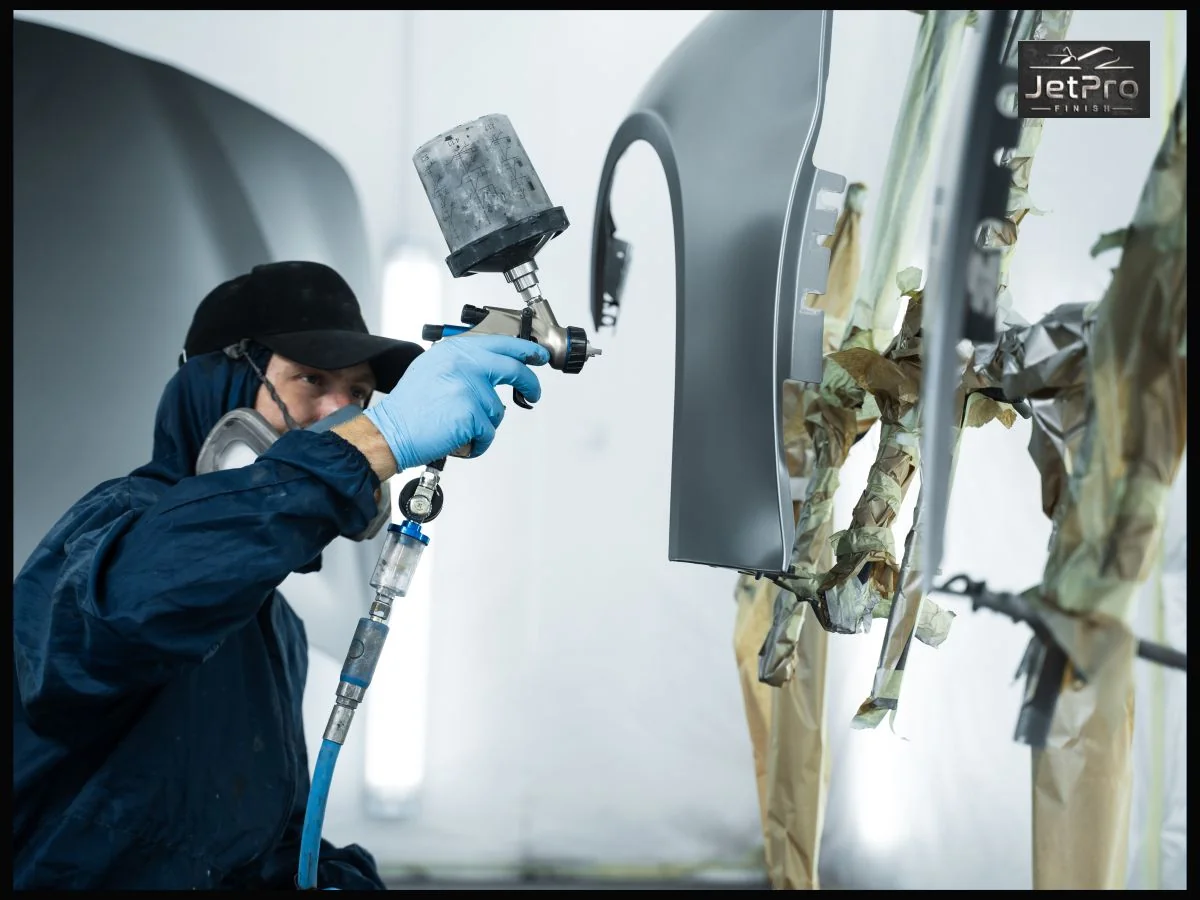
Aircraft surface preparation is a key factor that influences total aircraft painting cost.
What We Find Under the Existing Paint
Corrosion, previous repairs, and cracking or crazing in composite panels may not be visible until the existing finish has been removed.
JetPro Finish handles these discoveries through a documented process. Work outside the original quoted scope does not begin until a non-routine work card has been prepared, priced, and approved by the aircraft owner.
Some quotes include an allowance for a defined amount of corrective work. For example, the Citation CJ quote included ten hours of body work in the base price. Work beyond that allowance would be quoted separately.
This process gives the owner visibility into additional work before it proceeds.
Condition at Delivery
The aircraft should arrive ready for paint, with no active fluid leaks, all required panels permanently attached, and no unresolved maintenance that could affect the refinishing process.
Fluid leaks can compromise paint adhesion. Correcting issues that were not included in the original scope may be treated as non-routine work.
Resolving maintenance and configuration issues before induction helps protect the schedule and keeps the project aligned with the written quote.
What Is Included in the Quoted Price?
Every JetPro Finish quote lists the full scope of work in writing.
A complete strip-and-paint scope may include:
- Preliminary aircraft inspection
- Masking of windows, de-icer boots, and composite panels
- Chemical stripping
- Hot-water power washing
- Manual preparation with sandpaper and Scotch-Brite
- Removal of flight controls
- Painting flight controls separately from the airframe
- Application of PreKote conversion coating to bare metal
- Epoxy primer
- Two finish topcoats
- Scheme layout and stripe application
- Bright-work polishing
- New sealant at paint edges
- Required placards and aircraft markings
- Balancing and reinstallation of flight controls according to the maintenance manual
- Quality inspection with the owner
- Aircraft delivery
JetPro Finish supplies the consumables, chemicals, paint, primers, decorative paint masks, and maintenance-marking stencils included in the documented scope.
For turboprop and jet projects, JetPro Finish may also produce the livery drawing and provide design engineering as part of the quoted work.
Preparation and paint work are performed according to the applicable Structural Repair Manual and Aircraft Maintenance Manual requirements for the aircraft.
Payment Terms
JetPro Finish’s documented payment terms are:
- 50% due before aircraft induction
- Remaining balance due before acceptance and departure
- Quoted prices firm for 30 days
Any work outside the original scope is documented, priced, and presented for owner approval before it begins.
Why Aircraft Owners Choose JetPro Finish
Aircraft owners need more than an attractive finish. They need a clearly defined scope, an appropriate preparation process, accurate project expectations, and communication when the condition of the aircraft changes the work required.
JetPro Finish provides:
Aircraft-Specific Project Planning
Each aircraft is evaluated according to its existing finish, condition, configuration, proposed design, and project scope.
Written Scope and Pricing
The complete scope, quoted price, expected turn time, and payment terms are provided in writing before work begins.
Documented Non-Routine Work
Unexpected conditions discovered after the existing finish is removed are documented and priced before additional work proceeds.
Preparation Based on Aircraft Condition
JetPro Finish determines whether the existing finish should be sanded or completely stripped based on the technical condition of the aircraft.
Detailed Finishing Work
Project scopes can include airframe preparation, primer, topcoats, stripes, logos, registration markings, placards, bright-work polishing, edge sealant, and flight-control work.
Owner Review Before Delivery
The completed aircraft receives a quality inspection with the owner before acceptance and departure.
Aircraft Exterior Services
JetPro Finish provides aircraft exterior services for full repaint projects and more targeted finishing needs.
Partial Paint Services
Targeted paint work can address specific areas of the aircraft without requiring a complete repaint.
Learn about partial aircraft paint services →
Aircraft Restriping
Restriping services can update or restore the aircraft’s existing stripe design.
Learn about aircraft restriping →
Custom Logos and Decals
Custom logo and decal services allow owners and operators to apply branding, graphics, and other aircraft markings.
Learn about custom aircraft logos and decals →
Registration Number Changes
JetPro Finish provides professional registration-number updates as part of targeted marking work or a larger refinishing project.
Learn about aircraft registration-number changes →
Complete Exterior Work
Complete exterior scopes can include preparation, coatings, stripes, markings, bright work, sealant, and related finishing work.
Explore JetPro Finish exterior services →
Frequently Asked Questions About Aircraft Painting Cost
How much does it cost to paint an aircraft?
Based on verified JetPro Finish quotes issued between January 2025 and July 2026, complete piston-aircraft paint projects ranged from $25,000 to $42,000. A T-6 strip-and-paint project was quoted at $46,000. Turboprop and business-jet projects ranged from $68,000 for a King Air 300 to $180,000 for a Falcon 50.
Targeted projects can cost less than a complete repaint. A King Air 350 modification-related repaint was quoted at $18,500, while Falcon 50 registration-number and logo work was quoted at $28,500.
The final price depends on the aircraft, preparation method, existing finish, project design, and any conditions discovered after the old coating is removed.
How much does it cost to paint a Cessna 172?
JetPro Finish quoted a Cessna 172 sand-and-paint project at $25,000 over 18 working days. A Cessna 172 strip-and-paint project was quoted at $30,000 over 20 working days.
The appropriate preparation method depends on the condition and history of the existing finish.
What is the difference between sand and paint and strip and paint?
Sand and paint prepares a sound existing finish so the new coating system can adhere properly. It may be suitable when the current paint is stable and well-adhered.
Strip and paint removes the existing paint and primer before the airframe is prepared and refinished. It may be required when the existing finish is unsuitable as a foundation for another coating system.
Across three verified JetPro Finish comparisons, stripping added $5,000 and two working days compared with sanding.
How long does an aircraft paint job last?
Paint life depends on whether the aircraft is hangared or stored outside, the climate in which it operates, its utilization, ongoing maintenance, and whether the previous repaint was applied over a surface that should have been stripped.
The condition of the existing finish and the quality of the preparation process are important factors in the long-term performance of the completed coating system.
Is aircraft painting more durable than vinyl wrapping?
Yes, for durability. Vinyl wraps typically last three to five years; a properly applied paint system lasts considerably longer.
The appropriate option also depends on the aircraft, intended use, existing finish, desired design, and maintenance requirements.
Why can the final price change after the existing paint is removed?
Corrosion, previous repair work, and damage to composite components may not be visible before the existing finish is removed.
When JetPro Finish discovers a condition outside the original scope, the work is documented on a non-routine work card, priced, and submitted for owner approval before additional work begins.
Are flight controls painted separately?
A full strip-and-paint scope can include removing flight controls, painting them separately from the airframe, balancing them, and reinstalling them according to the aircraft maintenance manual.
The exact work included will be identified in the written quote.
How long does aircraft painting take?
Verified JetPro Finish turn times include:
- Cessna 172 sand and paint: 18 working days
- Cessna 172 strip and paint: 20 working days
- Piper Warrior 151 in overall white: 15 working days
- Piper Seminole 180 strip and paint: 20 working days
- T-6 strip and paint: 25 working days
- King Air 300 strip and paint: approximately five weeks
- Citation CJ strip and paint: 30 working days
- Citation 650 strip and paint: 30 working days
- Falcon 50 strip and paint: 40 working days
Actual scheduling depends on the aircraft, scope, design, existing condition, and approved non-routine work.
Final Thoughts
Aircraft painting cost depends on the aircraft’s size, configuration, existing finish, preparation requirements, design complexity, and the condition found underneath the old coating.
The verified JetPro Finish quotes on this page show how the price changes across different project types—from targeted marking and modification work to complete strip-and-paint projects for piston aircraft, turboprops, and business jets.
JetPro Finish prepares each quote around the individual aircraft and provides the scope, price, expected turn time, and payment terms in writing before work begins. When non-routine conditions are discovered, the additional work is documented and presented for owner approval before proceeding.
To receive an accurate price, provide JetPro Finish with information about your aircraft, its current finish, the proposed design, the work you want completed, and your preferred schedule.